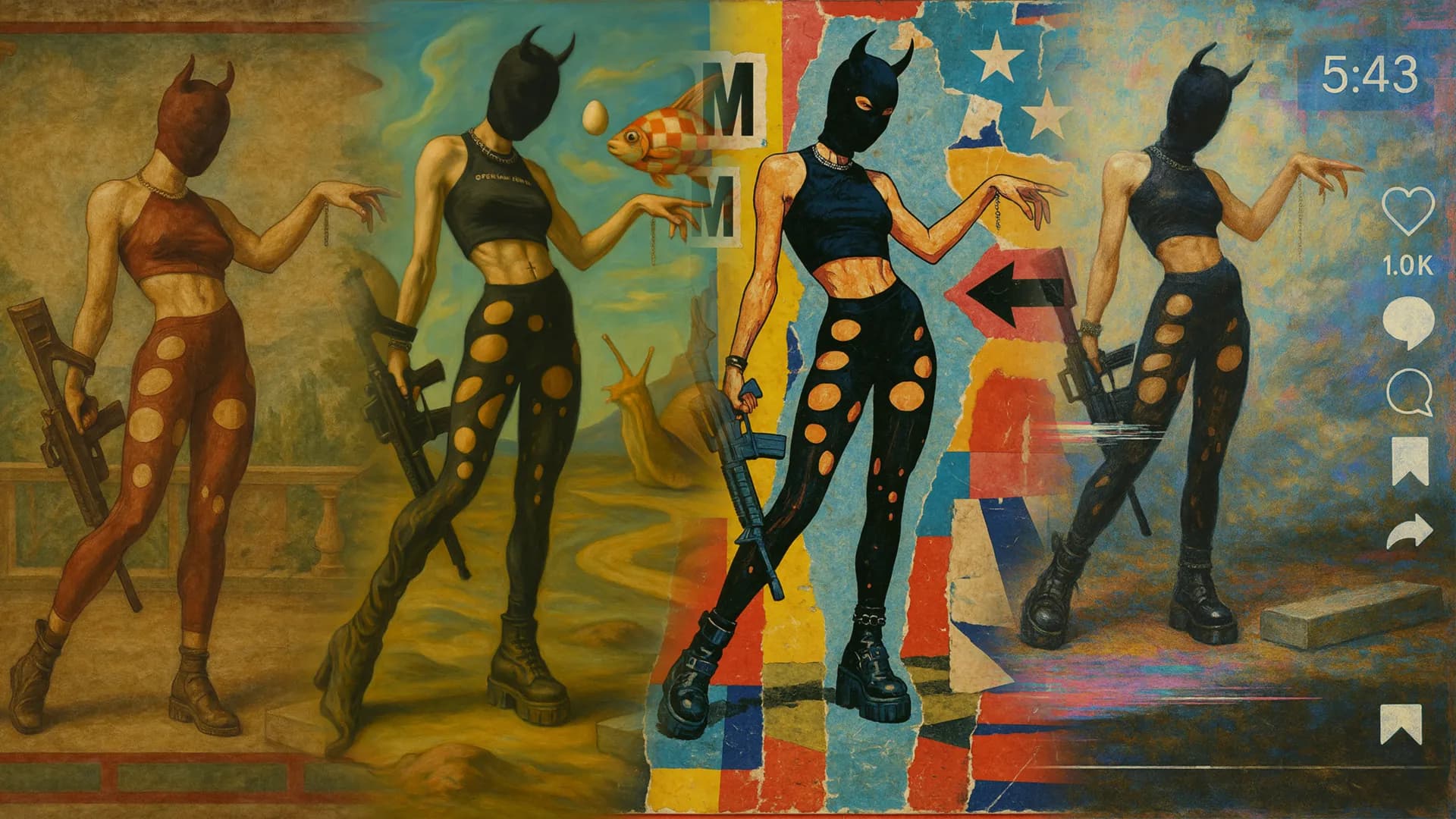
One Character, Many Eras: Art-History Test Bench
6 min read
Sometimes a new AI model drops, the internet fills with flying bears and cat-people, and we quietly ask a different question:
What happens if we point all this power backward – into art history – instead of only forward into novelty?
ECHONEO was born out of that question. Rather than racing to invent ever-stranger creatures, I wanted to see how far we could stretch a single idea across centuries of visual language without losing the thread of what makes it human.
This post is one of the more concrete examples of that attempt: a contemporary photograph echoed through 28 different art movements.
A quick reminder: what is ECHONEO?
ECHONEO is an ongoing collaboration between human intent and machine reflection. At its core is a simple structure:
- 28 art movements – from Prehistoric and Ancient Egyptian all the way to Conceptual and Contemporary art.
- For each movement we define:
- its historical context,
- conceptual concerns,
- and key visual strategies.
Using those definitions, we are systematically constructing a 28×28 matrix:
each cell is a generated artwork where the concept of one movement is rendered in the style of another.
The result is not a “style transfer toy,” but a kind of documentary grid:
784 small case studies on how ideas and aesthetics echo across time when filtered through an AI that has been asked to care about context.
This new series takes that logic and applies it to something much closer to our present:
a single photograph from today.
The starting point: a contemporary icon
Just yesterday I came across a striking photograph by @ave.repin featuring @acidbtch: a masked figure with horns, cropped top, weapon in hand, standing with a calm yet charged posture in a minimal set.
It sits perfectly at the intersection that ECHONEO is interested in:
- fashion and subculture,
- anonymity and performance,
- threat and elegance,
- the visual language of online images.
Instead of using a neutral or “generic” subject, I wanted to see what happens when a very 2020s character is asked to travel through centuries of art history.
So this time, the experiment was:
Take one contemporary figure and re-render it 28 times,
each time through the lens of a different art movement.
The objective was not to imitate any photographer or to claim originality over the character, but to treat the image as a case study inside a broader research project.
28 movements, one pose
In the gallery below, you’ll see the same figure refracted through:
- Prehistoric cave wall logic – reduced to simple marks and earth pigments.
- Ancient Egyptian composite view on a papyrus-like surface.
- Greek vase silhouette and red-figure conventions.
- Roman fresco realism with architectural framing.
- Byzantine mosaic with gold tesserae and flattened, iconic presence.
- Romanesque and Gothic stiffness and hierarchy.
- Renaissance balance and anatomical idealization.
- Mannerist elongation and serpentine tension.
- Baroque drama and tenebrism.
- Rococo lightness and ornament.
- Neoclassicism, Romanticism, Realism, Impressionism, Post-Impressionism…
- through to Fauvism, Expressionism, Cubism, Futurism, Dada, Surrealism, Abstract Expressionism, Pop Art, Minimalism, Conceptual Art, Postmodernism and Contemporary Art itself.
The silhouette and basic composition stay constant.
Everything else – light, color, material, symbolism, even the idea of what the figure represents – is allowed to shift according to the conceptual brief of each movement.
This is where the scale of 28×28 becomes easier to feel.
Even one row of 28 already shows how much friction and meaning can be generated when a single image is forced to “speak” in so many dialects of art.
A detour before the full grid
The full ECHONEO matrix is still under construction. Most of it currently lives as:
- movement definitions and prompt schemas,
- partial runs and test rows,
- and a growing collection of notes rather than a polished, public grid.
This 28-image series came from a different, more immediate place.
Just yesterday, that single photograph by @ave.repin with @acidbtch hit exactly the ECHONEO nerve — and instead of waiting for the “perfect” moment to reveal a finished matrix, I decided to follow that spark. I spent the evening and most of the night building a complete 28-movement walk for this one character.
So rather than unveiling a finished 28×28 spreadsheet of echoes, this post shows one fully traversed row: one figure carried through 28 art movements.
That makes the scale of the project much easier to feel:
- you see a character that clearly belongs to our era,
- translated into visual languages many people recognize from museums, books, or memes,
- arranged so that art history reads like a sequence of filters applied to the same subject.
In that sense, this gallery is not “the main project,”
but a snapshot from the middle of the process – a detour that turned into a concrete, shareable chapter.
From flying bears to quiet documentation
When the latest generation of image models arrived, it was tempting to stay in the playground of pure novelty:
human-cats, cat-humans, bears with wings, planets made of glass noodles.
There is nothing wrong with that space, but for ECHONEO I was more interested in the opposite direction:
- take the most serious, dusty, textbook part of visual culture – art history,
- and ask a very modern tool to walk through it carefully,
- not to outperform the masters, but to document how well it can listen.
The goal here is not to declare that “this is art now” or that historical styles are solved problems.
If anything, the project keeps reminding me that we are in a transition period where the definition of art is mutating again, and that it’s useful to have a few projects that behave almost like visual field notes of that transition.
ECHONEO is my attempt at such a record:
a way to look at AI images without forgetting how we got here.
What this means for your own images
One important point: this series is not about this specific character alone.
The underlying prompts, concepts and movement definitions are reusable.
In principle, any photographer or visual artist could take their own character or scene and pass it through the same conceptual pipeline:
- keep your composition and pose,
- change the conceptual + stylistic brief (Prehistoric, Gothic, Pop, Conceptual, …),
- see how your work echoes across time.
In that sense, the 28 images here are:
- a case study for ECHONEO,
- a tool preview for others,
- and a reminder that AI-assisted art can also be about context, lineage and documentation, not only spectacle.
Credits and respect
This entire series exists because of one strong photograph.
- Original photography and character concept:
@ave.repin - Model / character embodiment:
@acidbtch
The images shown here are non-commercial, experimental reinterpretations created purely for the ECHONEO research project. They are not meant to replace or dilute the original work, but to serve as a documented example of how a single contemporary icon can resonate through different historical lenses.
If the original creators ever feel uncomfortable with this study being displayed, I will happily adjust or remove the related materials.
Until then, consider this gallery a small, carefully documented echo:
one masked figure standing at the junction of thousands of years of art –
and whatever comes next.