Echoneo-2-3: Ancient Greek Concept depicted in Ancient Roman Style
10 min read
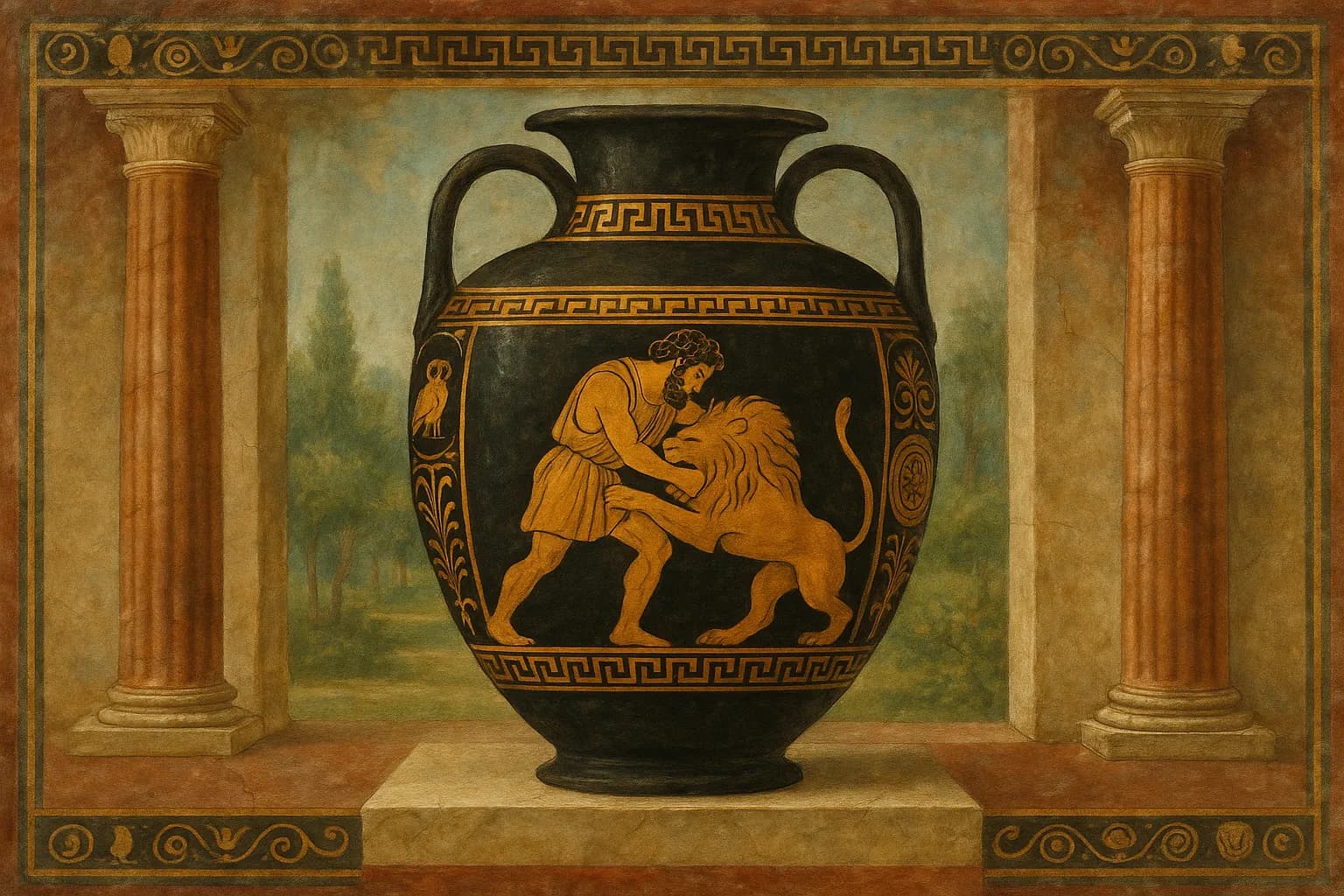
Artwork [2,3] presents the fusion of the Ancient Greek concept with the Ancient Roman style.
The Concept: Ancient Greek Art
At its philosophical heart, Ancient Greek art was a profound inquiry into humanity's place within the cosmic order, relentlessly pursuing ideal beauty and the principles of balanced governance. Spanning roughly from the Minoan period through the Hellenistic age, but deeply embodied in the Classical and Late Classical periods exemplified by a master like Exekias, it wrestled with the intricate dance between reason and raw emotion, and the inexorable hand of fate.
Core Themes: The art consistently articulated the Human Ideal, positing a perfected form for both physique and character. Reason and Logic were paramount, guiding artistic proportion and narrative clarity. Beauty and Harmony were not mere aesthetic choices but reflections of a universal order. Principles of Measure and Proportion were meticulously applied, underpinning the visual rhythm and balance. Furthermore, it explored civic virtue within the context of Democracy and Citizenship, often through the lens of timeless Myth.
Key Subjects: The primary focus revolved around depicting scenes from Greek mythology—heroic deeds of gods and mortals—or the rigorous discipline of athletic competition. These narratives were rendered with remarkable clarity, often on the surfaces of ceramic vases. We see dynamic action, like Heracles grappling with the Nemean Lion, where struggle is conveyed through powerful pose rather than graphic detail, or the frozen motion of athletes mid-stride or mid-throw. Divine figures like Athena appear with their iconic attributes, their essence captured through stylized form rather than hyper-realism. The emphasis was always on representing heroic or divine action within the specific constraints of the medium, fostering immediate comprehension.
Narrative & Emotion: The narrative purpose was paramount: to tell a story with elegant precision. The intended emotional response was not one of overwhelming pathos, but rather admiration for heroic action, a sense of intellectual clarity derived from balanced composition, and an appreciation for stylized beauty. The art sought to evoke a feeling of balance, harmony, and inherent order, imbued with a distinct narrative energy. It celebrated the dignity and dynamism of its figures, elevating mythological or athletic achievement to a realm of enduring, idealized significance.
The Style: Ancient Roman Art
The aesthetic mandate of Ancient Roman art, particularly its fresco painting, represented a significant departure from Greek idealism, embracing a more terrestrial and illusionistic vision. Emerging around 500 BCE and flourishing well into the Imperial era, this style was characterized by its profound commitment to realism and the creation of immersive spatial environments.
Visuals: Ancient Roman fresco painting prioritized the realistic depiction of figures and their surroundings. It excelled in verism, particularly in portraiture, capturing individual features with unflinching accuracy. Through sophisticated use of chiaroscuro modeling, forms gained tangible three-dimensional volume. Illusionistic techniques, including linear and atmospheric perspective, were deftly employed to suggest profound spatial depth, inviting the viewer to look into the painted world rather than simply at it.
Techniques & Medium: The chosen medium was predominantly fresco, applied to plaster walls, resulting in a smooth, polished surface. Key technical innovations included the mastery of chiaroscuro for volumetric rendering and a precocious understanding of perspective to construct convincing spatial illusions. Unlike earlier art forms, it consciously avoided flatness, heavy outlines, overt stylization, or any hint of photorealism; its aim was a curated, convincing reality.
Color & Texture: The palette was rich and varied, celebrating the natural world with vibrant Pompeian Reds, deep yellows, verdant greens, cerulean blues, profound blacks, and crisp whites. This expansive range facilitated naturalistic representation. The surface finish was consistently smooth, a characteristic of true fresco, allowing for meticulously detailed painted textures that convincingly mimicked materials like polished marble, flowing fabric, and lush foliage.
Composition: Compositions were typically dynamic and complex, often framed by painted architectural elements such as columns, arches, or simulated garden landscapes. This framing served to reinforce the illusion of depth and acted as a window into the depicted scene, rather than a flat backdrop.
Details: A hallmark of Roman fresco was its dedication to naturalistic lighting, meticulously depicted within the painted scene to model forms and convey realistic volume. An eye-level perspective was frequently adopted, further enhancing the illusion of depth and drawing the viewer into the scene's immediate reality. The entire approach aimed for a seamless, fresco-like finish, entirely devoid of visible brushstrokes or impasto, ensuring a highly refined and controlled aesthetic. Its specialty lay in its ability to transform a flat wall into a convincing, immersive environment, a testament to its technical prowess and its embrace of experiential realism.
The Prompt's Intent for [Ancient Greek Concept, Ancient Roman Style]
The algorithmic brief for coordinates [2,3] presented a truly fascinating intellectual challenge: to reconcile two fundamentally divergent artistic philosophies within a single output. The specific creative conundrum was to imbue the conceptual essence of Ancient Greek art – its heroic narratives, idealized forms, and stylized clarity – with the distinctive visual language and technical mastery of Ancient Roman fresco painting.
The instructions were precise in demanding this unique synthesis. The AI was tasked with depicting a scene from Greek mythology or athletic competition, echoing the core subjects and narrative clarity of the Hellenic tradition. However, this content was not to be rendered in the graphic, two-dimensional style of a black-figure vase. Instead, it demanded execution in the full, illusionistic register of a Roman wall painting.
This implied a deliberate tension: how does one translate the stylized figures and narrative clarity typical of vase painting – where action is represented through pose and contour – into the realistic depiction, volumetric modeling, and spatial depth characteristic of Roman verism? The AI had to achieve the "admiration for heroic action" and "stylized beauty" of the Greek concept, but do so using chiaroscuro, linear perspective, and a naturalistic palette. The challenge lay in making a Greek myth feel "real" and immersive, as if painted on the wall of a Pompeian villa, while still retaining its inherent dignity, balance, and the dynamic spirit of its Hellenic origin. It was a directive to bridge the gap between idealized form and tangible illusion, between conceptual representation and material reality.
Observations on the Result
Upon viewing the generated artwork for coordinates [2,3], one is immediately struck by the sophisticated resolution of the prompt's inherent paradox. The AI has deftly interpreted the directive to fuse Ancient Greek conceptual elements with Ancient Roman stylistic characteristics, delivering an image that feels both familiar and uncannily novel.
The visual outcome is an undeniable Roman fresco, replete with the characteristic smooth surface and rich, earthy color palette of Pompeian walls. We see a convincing illusion of depth, achieved through the skillful application of linear and atmospheric perspective, drawing the eye into the scene. Figures possess tangible volume, modeled convincingly through chiaroscuro, a hallmark of Roman naturalism. Architectural elements – perhaps a colonnade or a painted garden vista – frame the narrative, anchoring it firmly within the domestic or public spaces favored by Roman patrons.
What is particularly successful is the AI's ability to maintain the narrative clarity and dignity of the Greek concept despite the profound shift in visual language. The chosen scene, likely mythological or athletic, reads instantly, a testament to the AI's grasp of Greek storytelling principles. The figures, while rendered with Roman realism, retain the dynamic action and heroic presence envisioned in the Greek brief. Their postures convey struggle or triumph with a powerful sense of classicism, rather than a mere photographic snapshot.
A surprising element is how the AI navigates the "stylized figures wearing simple tunics or classical drapery." Instead of a flat, outline-based stylization, the garments are rendered with realistic folds and textures, yet their arrangement still evokes the measured grace and iconic flow of classical Greek drapery, a blend of veristic detail and idealized form. The balance, harmony, and order characteristic of Greek composition are evident in the overall arrangement, even within the complex, multi-layered Roman composition.
There is perhaps a subtle dissonance for the purist: the lack of the inherent spiritual distance or the monumental clarity of true Greek sculpture or vase painting. The Roman style, with its veristic grounding, inevitably pulls the heroic into a more immediately human, almost tangible, sphere. This isn't a critique, but rather an observation on the fascinating transformation that occurs when the "human ideal" is presented through a lens so dedicated to human reality. The image is a masterful synthesis, a "Romanized" glimpse into the Hellenic soul.
Significance of [Ancient Greek Concept, Ancient Roman Style]
This particular algorithmic alchemy, bridging the Hellenic ideal with Roman verism, yields profound insights into the latent potentials and hidden assumptions within both art movements. It reveals that beneath their distinct aesthetic surfaces, there existed a shared appreciation for narrative power and the human form, albeit expressed through dramatically different means.
One significant revelation is how the Greek concept of the "Human Ideal" endures even when stripped of its characteristic stylization. When viewed through the lens of Roman naturalism, the heroic and the divine gain a startling immediacy. Achilles and Ajax are no longer silhouetted myths on a ceramic surface; they are vibrant, fleshy beings, occupying tangible space, their muscles and expressions rendered with a veristic precision that amplifies, rather than diminishes, their heroic gravitas. This fusion suggests that the conceptual strength of Greek art was robust enough to transcend its original stylistic conventions, proving its enduring appeal and adaptability.
Conversely, this collision exposes a latent capacity within Roman art for elevated, idealized content. While Roman art often focused on civic life, portraiture, and domestic scenes, applying its masterful illusionistic techniques to a purely mythological Greek narrative elevates its scope. It demonstrates that Roman verism was not merely a tool for depicting mundane reality but could equally serve to make the grand narratives of antiquity feel profoundly present and accessible, bridging the spiritual distance often perceived in Greek idealism with a tangible, visual reality.
The new meanings that emerge are particularly compelling. We see an irony in the precise, almost scientific observation of the Roman style being applied to the often-symbolic or archetypal figures of Greek myth. Yet, this irony blossoms into a new beauty: a form of "heroic realism" where the ideal is grounded, and the mythological becomes relatable. It’s as if the Romans, in their pragmatic embrace of the tangible, sought to bring the distant, perfect world of the Greeks into their own villas, making the myths feel less like abstract ideals and more like vivid, lived histories.
This Echoneo experiment thus underlines a crucial point for understanding art history: styles are not merely superficial veneers but deeply embedded philosophies. Yet, AI’s capacity to deconstruct and reassemble these elements reveals that the underlying conceptual DNA can be remarkably resilient, capable of generating new, unexpected aesthetic dialogues that challenge our conventional categorizations and expand our appreciation for the enduring power of human creativity across millennia.
The Prompt behind the the Artwork [2,3] "Ancient Greek Concept depicted in Ancient Roman Style":
Concept:Depict a scene from Greek mythology or athletic competition, rendered clearly on a vase surface. Focus on dynamic action and narrative clarity using stylized figures wearing simple tunics or stylized classical drapery. Visualize representations such as Heracles wrestling the Nemean Lion (show struggle through pose, not graphic detail), or athletes competing (running figures, discus thrower mid-motion), or Athena with her symbolic attributes (owl shape, shield pattern, spear). Emphasize balance, clarity in storytelling, and the *representation* of heroic or divine action within the vase painting tradition.Emotion target:Inspire admiration for heroic action, intellectual clarity, and stylized beauty. Evoke a sense of balance, harmony, order, and narrative energy. Capture the dignity and dynamism of the figures as represented in classical vase art, celebrating mythological or athletic achievement.Art Style:Use the Ancient Roman fresco painting style characterized by realistic depiction of figures and settings, with a strong emphasis on verism in portraiture. Apply chiaroscuro modeling to create three-dimensional volume and use illusionistic techniques, such as linear and atmospheric perspective, to suggest spatial depth. Utilize a rich, varied color palette including Pompeian Reds, yellows, greens, blues, blacks, and whites for naturalistic representation. Ensure a smooth, polished fresco surface with detailed painted textures representing materials like marble, fabric, and foliage. Favor dynamic, complex compositions framed by architectural elements, while avoiding flatness, heavy outlines, stylization, and photorealism.Scene & Technical Details:Render in a 4:3 aspect ratio (1536×1024 resolution) using naturalistic lighting depicted within the painted scene to model forms and convey realistic volume. Adopt an eye-level perspective to reinforce the illusion of depth, employing architectural framing and perspective techniques typical of Roman wall paintings. Maintain a smooth, fresco-like finish, avoiding visible brushstrokes or impasto. Frame the narrative with painted architectural elements such as columns, arches, or garden landscapes, and steer clear of medieval stylistic conventions, gold backgrounds, and purely symbolic or cartoonish representations.