Echoneo-26-24: Postmodernism Concept depicted in Minimalism Style
7 min read
Artwork [26,24] presents the fusion of the Postmodernism concept with the Minimalism style.
As the architect of the Echoneo project, it is with considerable fascination that I delve into the latest AI-generated artwork, specifically the fusion at coordinates [26,24]. This particular piece presents a captivating interplay, a collision between two pivotal moments in art history, orchestrated through algorithmic intent. Let us dissect its profound implications.
The Concept: Postmodernism
Emerging around the 1970s, the Postmodern concept marked a profound philosophical and artistic shift, characterized by a fundamental skepticism towards what were previously considered universal truths and overarching narratives. It was a period of intense re-evaluation, where established histories and cultural hegemonies were rigorously interrogated, and the very fluidity of identity became a central concern.
Core Themes: At its heart, Postmodernism embraced the rejection of Grand Narratives, challenging any singular, authoritative interpretation of reality or history. This led to a pervasive sense of fragmentation and eclecticism, where disparate elements were often juxtaposed without hierarchical ordering. Irony, pastiche, and parody became favored rhetorical devices, allowing artists to appropriate and recontextualize existing imagery with a knowing, often critical, wink. The politics of identity—exploring issues of gender, race, and class—also gained significant prominence.
Key Subjects: The Postmodern artistic landscape was rich with subjects that intentionally mixed styles, cultural references, and materials from diverse periods, blurring boundaries between "high" and "low" art. Everyday objects, media imagery, and art historical canons were ripe for re-interpretation and subversion. Questions of originality and authorship were actively deconstructed, often through appropriation.
Narrative & Emotion: The prevailing narrative was one of deconstruction and reassembly, often playful yet deeply critical, embracing complexity and inherent contradictions rather than seeking simplistic resolutions. Emotionally, the movement aimed to evoke a sense of irony, informed skepticism, or critical awareness. Depending on the artist's specific intent, viewers might experience amusement, a disorienting sense of nostalgia through repurposed imagery, or a heightened recognition of reality's constructed, layered nature.
The Style: Minimalism
The Minimalism style, flourishing from the early 1960s, represented a radical reduction of artistic expression to its most fundamental elements. It was a concerted effort to strip away the illusionistic, narrative, and expressive qualities of art, advocating for an aesthetic that was purely self-referential and objective.
Visuals: Minimalism emphasized extreme simplicity of form, utilizing basic geometric shapes like cubes, squares, lines, and grids. Its visual lexicon was non-representational and entirely non-referential, aspiring to a pure, objective presence. The rejection of traditional pictorial space led to works that asserted their physical presence as objects rather than windows into another world.
Techniques & Medium: Artists employed techniques that ensured an impersonal, fabricated appearance, deliberately removing any visible traces of the artist's hand. This often involved industrial materials such as polished steel, plexiglass, and raw wood. Painting, when present, featured precise, flat applications of monochromatic color, emphasizing material and form over gestural expression. Repetition and serial structures were frequently used to create systematic arrangements.
Color & Texture: Color palettes were typically monochromatic or limited to a restrained spectrum, applied with uniform flatness. Textures were industrially fabricated – smooth, uniform, and devoid of expressive marks, highlighting the material's inherent qualities rather than creating illusion. Lighting was often flat, bright, and even, minimizing shadows to emphasize the absolute geometry and physical presence of the forms.
Composition: Compositions were characterized by strict symmetry, seriality, and an unwavering simplicity. They eschewed complex arrangements or dramatic focal points, instead focusing on the systematic arrangement of identical or subtly varied units. The strict, straight-on camera view, as specified in the prompt, perfectly encapsulates this desire for unmediated, objective presentation, emphasizing the artwork's physical rather than narrative dimensions.
Details: The speciality of Minimalism lay in its radical commitment to objecthood and its rejection of subjective interpretation. Every detail—from the precise edges of a form to the seamless application of paint—contributed to an overall aesthetic of stark clarity and uncompromising objectivity, turning the artwork into a self-contained entity rather than a vehicle for external meaning.
The Prompt's Intent for [Postmodernism Concept, Minimalism Style]
The specific creative challenge posed to the AI was to engineer a visual paradox: to imbue the cool, objective, and non-referential aesthetic of Minimalism with the ironic, fragmented, and referential spirit of Postmodernism. The instructions aimed not for a gentle blend, but a purposeful, generative friction.
The core intent was to push the AI beyond a mere stylistic application, demanding a conceptual integration. How could extreme simplicity—Minimalism's hallmark—be used to manifest Postmodern critique? The AI was tasked with visualizing an artwork that, while adhering to Minimalism’s strict geometric forms, industrial finishes, and impersonal execution, would simultaneously, perhaps subtly, engage in pastiche or appropriation. This meant the machine had to find a way to make a non-representational style represent something, or at least reference something, in an ironic or deconstructive manner. The emphasis on a uniform, shadowless environment and a direct camera view was designed to heighten the clinical precision, making any introduced Postmodern "contamination" more starkly evident against the backdrop of austere objectivity.
Observations on the Result
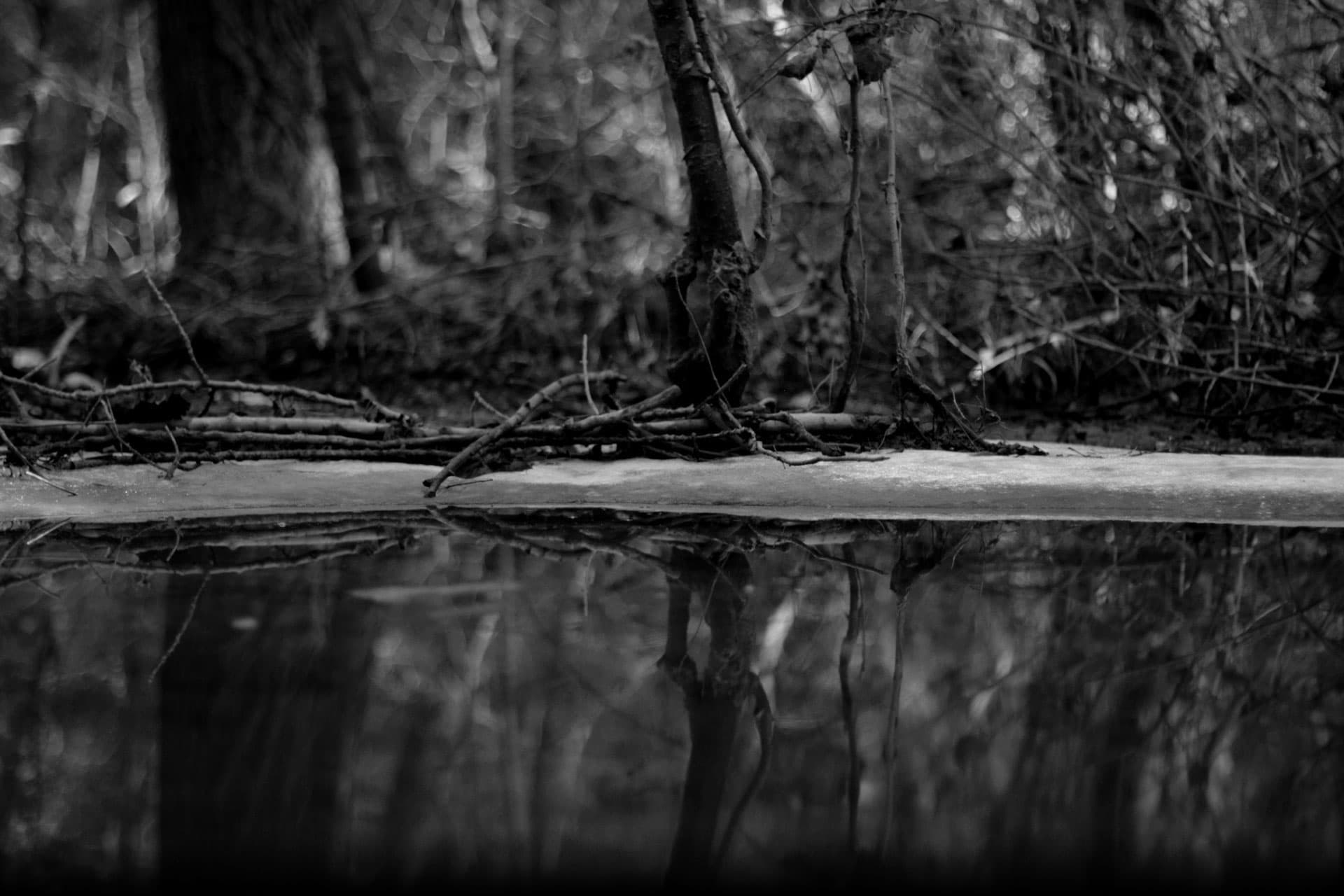
The AI's interpretation of this complex prompt is, in a word, unsettlingly brilliant. The resulting image presents what initially appears to be a quintessential Minimalist composition: a series of perfectly rendered, highly polished, dark metallic rectangular prisms, arranged in a precise, almost grid-like configuration. The lighting is absolutely flat and even, dissolving all shadows and reinforcing their status as pure, unadorned objects. The surfaces are impeccably smooth, devoid of any expressive mark, embodying the impersonal aesthetic.
However, a closer inspection reveals the subtle yet profound integration of the Postmodern concept. Within the highly reflective surfaces of these pristine Minimalist forms, one discerns not a clear reflection of the environment, but a diffused, almost ethereal ghosting of what appear to be fragmented, recontextualized photographic details. These are not sharp images, but rather spectral blurs, reminiscent of Gerhard Richter’s photo-paintings, yet rendered with a digital sterility that is entirely alien to a painter's hand. One might detect the faint, distorted echo of a historical portrait, or a fleeting, unidentifiable snippet of popular culture, precisely contained within the geometry. The success lies in the AI's ability to maintain Minimalist integrity while embedding a referential element that feels both alien and integral. The surprising dissonance arises from this juxtaposition: the utter objectivity of the form housing a subjective, fragmented memory. The very 'impersonality' of the AI's rendering perfectly mirrors Postmodernism's challenge to authorship, as the "artist's hand" is not merely absent but algorithmically rendered, making the pastiche an act of pure, detached computation.
Significance of [Postmodernism Concept, Minimalism Style]
This unique fusion, orchestrated by the Echoneo system, reveals profound latent potentials and inherent ironies within both art movements. On one hand, it exposes Minimalism’s hidden capacity for narrative. While Minimalist artists vehemently rejected external meaning, this AI-generated artwork demonstrates that even the most starkly objective forms can be imbued with referential content, especially when subjected to an external, guiding conceptual framework. The "purity" of Minimalism, when viewed through a Postmodern lens, becomes a canvas for subtle, almost subliminal, commentary.
Conversely, the fusion highlights a surprising alliance between Postmodernism's distrust of grand narratives and Minimalism's rejection of expressive gesture. The impersonal, fabricated aesthetic of Minimalism, devoid of the artist's subjective touch, becomes the perfect vehicle for Postmodern questioning of authorship and the constructed nature of reality. The AI, functioning as a non-human author, embodies the Postmodern critique of originality, creating pastiche without human intent or subjective interpretation. This collision yields a new form of beauty—a sterile, almost clinical beauty born from algorithmic precision—that simultaneously carries a deep, unsettling irony. It suggests that even in a digital age, where images are infinitely reproducible and styles endlessly combinable, the fundamental questions of meaning, authenticity, and perception, central to both movements, continue to resonate with amplified complexity.
The Prompt behind the the Artwork [26,24] "Postmodernism Concept depicted in Minimalism Style":
Concept:Visualize an artwork that intentionally mixes styles, references, or materials from different periods or cultural contexts (pastiche, appropriation). It might involve irony, parody, or humor, perhaps juxtaposing "high art" elements with imagery from popular culture or kitsch. The work might challenge notions of originality, authorship, or grand narratives, embracing fragmentation, complexity, and contradiction.Emotion target:Evoke a sense of irony, playfulness, skepticism, or critical awareness. Challenge the viewer's assumptions about style, meaning, and value. Depending on the specific approach, it might elicit amusement, disorientation, nostalgia (via appropriation), or encourage a recognition of cultural complexity and the constructed nature of reality.Art Style:Apply the Minimalism style, emphasizing extreme simplicity of form through basic geometric shapes such as cubes, squares, lines, and grids. Maintain a non-representational, non-referential, and objective aesthetic. Focus on industrial materials (like polished steel, plexiglass, raw wood) or monochromatic geometric painting with precise, flat application. Remove any visible traces of the artist's hand, ensuring an impersonal and fabricated appearance. Use repetition, serial structures, and systematic arrangements without expressive gesture, ornamentation, or complex compositions.Scene & Technical Details:Render the artwork in a 4:3 aspect ratio (1536×1024 resolution) using flat, bright, and even lighting with no discernible shadows. Maintain a strict, straight-on camera view, emphasizing the physical presence, geometry, and materiality of the forms. Avoid traditional depth, realistic perspective, dynamic poses, or textured brushwork. Surfaces should appear industrially fabricated — smooth, uniform, and devoid of expressive marks — highlighting symmetry, seriality, and simplicity within the overall composition.